Why your car can be a reliable power source
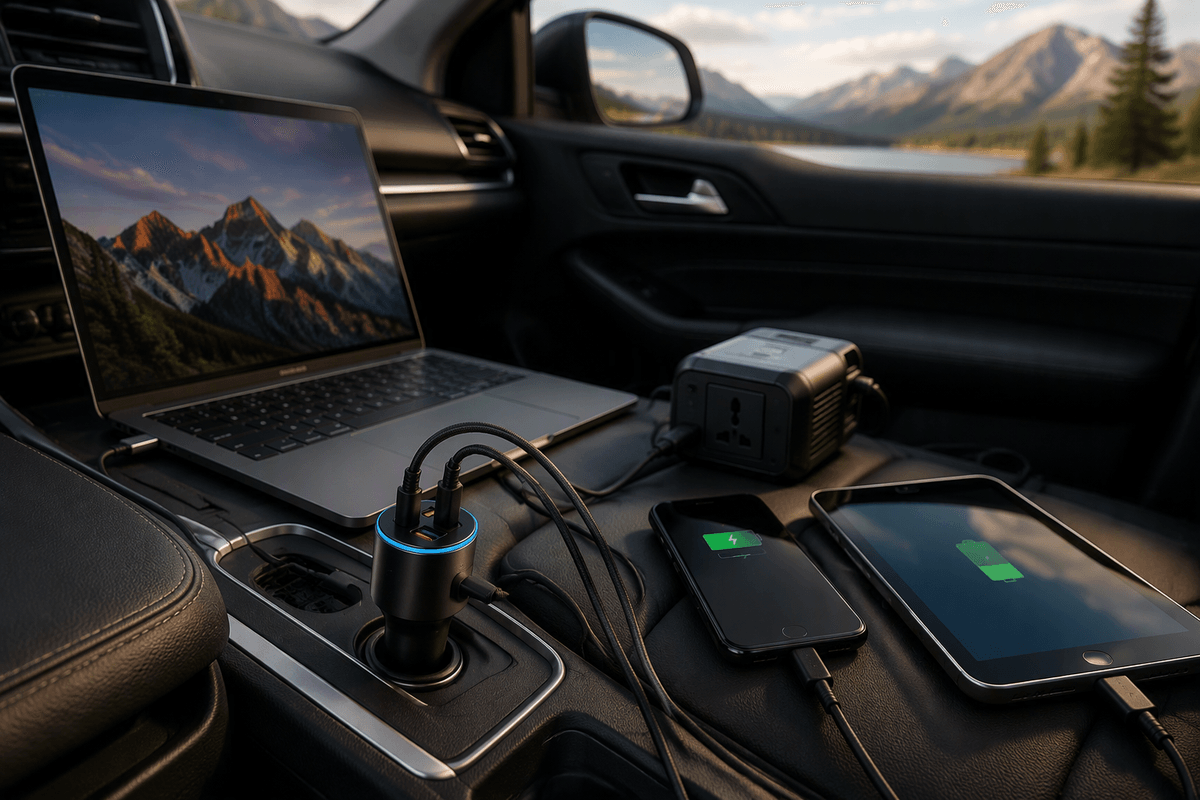
You’ve probably noticed your phone charges fine in the car day after day, even on long drives. That’s not luck—your vehicle is built around an electrical system designed to run critical loads reliably, then keep the battery topped off while the engine is running. With the alternator producing power and the battery acting like a buffer, small electronics see a steadier supply than they would from many cheap wall adapters or old power banks.
The practical catch is that “reliable” doesn’t mean “unlimited.” The 12V system has real limits set by the socket, wiring, and fuses, and those limits vary by vehicle. Heat, vibration, and loosely fitting plugs also matter on the road, so the right adapter and a tidy setup make a bigger difference than most people expect.
What the 12V socket actually provides (and what it doesn’t)
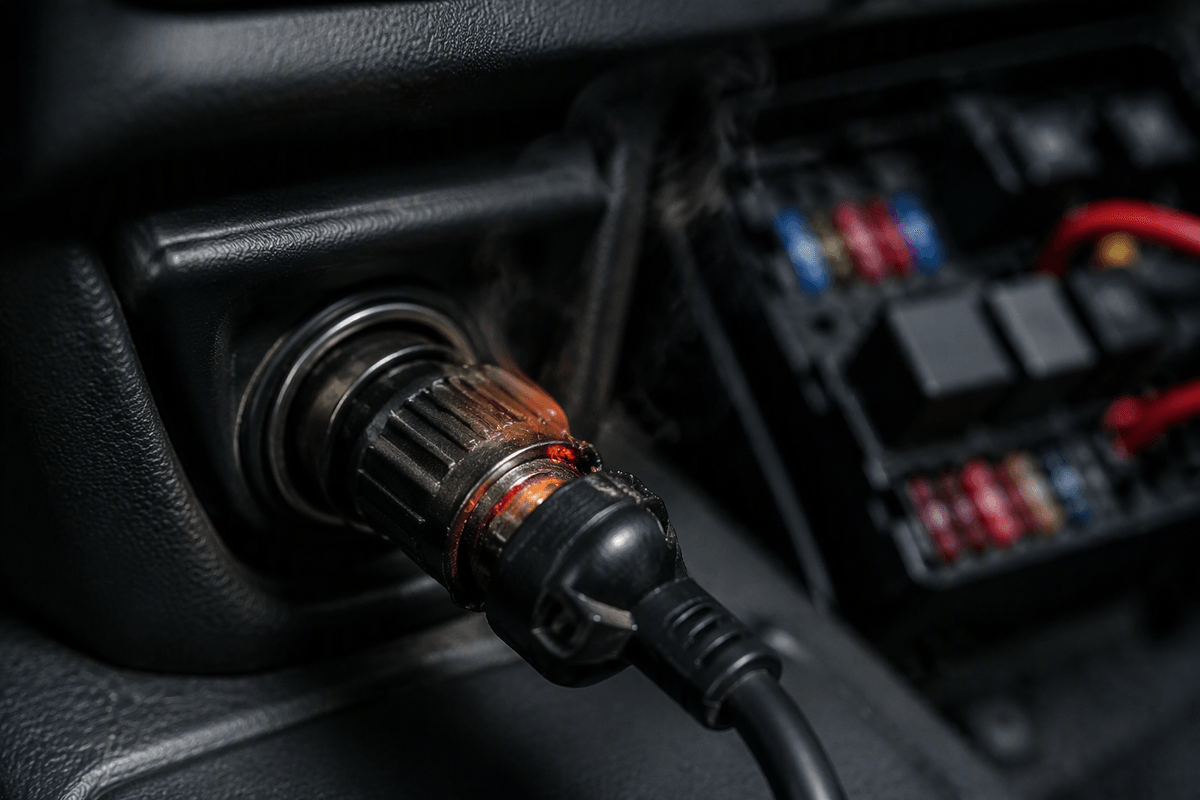
That “12V” socket is really a car’s accessory circuit, and the voltage isn’t always 12. With the engine off you’ll often see roughly 12–12.6V at the battery; with the engine running it’s commonly closer to 13.5–14.5V. Most phone chargers handle that range easily because they convert it down to stable 5V (or 9V/12V for fast charging). The socket’s real promise is simple: it can deliver DC power up to the vehicle’s fuse limit, not clean household-style power.
What it doesn’t provide is a USB port by itself, or a “safe” amount of power for anything you plug in. Many sockets are fused around 10A or 15A, which sounds big until you remember that’s shared with the wiring and plug quality. High-draw devices can heat the plug, loosen it over bumps, or trip the fuse. It also won’t run most wall-plug gear unless you add an inverter, and using it with the engine off can drain the starter battery faster than people expect.
Choosing the right adapter: USB-A, USB-C PD, or 12V plug
Most people start with a basic USB-A car charger, and it’s still the right choice for simple jobs: phones, earbuds, GPS units, and older cameras. The key is the labeling. A single “5V/2.4A” port is about 12W; “QC/fast charge” or “18W” usually covers many Android fast-charge modes, but it won’t reliably run tablets at full speed, and it won’t charge most laptops. Cheap multi-port units also tend to share one small power budget across all ports, so everything slows down when you plug in a second device.
If you carry a newer phone, tablet, handheld console, or a USB-C laptop, prioritize a USB-C PD (Power Delivery) adapter. Look for a clear watt rating per port—30W is a common minimum for tablets, while many laptops want 45–65W to charge normally. A straight 12V plug (no USB) is for gear that already expects car power—portable coolers, some air pumps, certain camera chargers—just make sure the plug fits tightly and the device’s draw doesn’t push the socket’s fuse.
When you need an inverter to power wall-plug devices
You’ll know you need an inverter when the device expects a normal wall plug (AC) and there isn’t a car-friendly DC option. Common examples are a laptop charger brick that doesn’t accept USB-C, a camera battery charger with only a two-prong plug, a small CPAP, or a tool battery charger. An inverter turns the car’s 12–14V DC into household-style AC, so the device can use its regular charger.
The trade-off is efficiency and heat. That conversion wastes power, so a “90W” laptop charger can pull noticeably more than 90W from the socket, and cheap inverters can run hot in a cupholder. Choose a pure sine wave inverter for anything sensitive (some medical gear, certain audio equipment), and don’t expect a tiny 150W inverter to handle a hair dryer, kettle, or anything with a heating element. If the inverter has battery clips, that usually means it’s meant to draw more than a 12V socket safely supports.
Doing the watt math before something blows a fuse
You’ve felt it: everything is charging fine, then you plug in one more thing and the 12V socket goes dead. That’s usually a fuse doing its job. The quick math is watts = volts × amps. Most car sockets are fused at 10A or 15A. With the engine running around 13.5–14.5V, that’s roughly 135–145W on a 10A circuit or 200–220W on a 15A circuit. In real use, plan lower because the plug, wiring, and adapter heat up long before the fuse rating feels “comfortable.”
Add up what you’re actually drawing. A 65W USB-C laptop charge plus a 30W tablet plus a 20W phone is already 115W, and an inverter can add another 10–25% overhead. If your adapter says “120W total shared,” that means all ports together—not each. When in doubt, run the highest-draw device alone, then add smaller loads and feel the plug after 10 minutes; warm is normal, hot is a warning to back off.
A practical setup for multiple devices in a real car trip
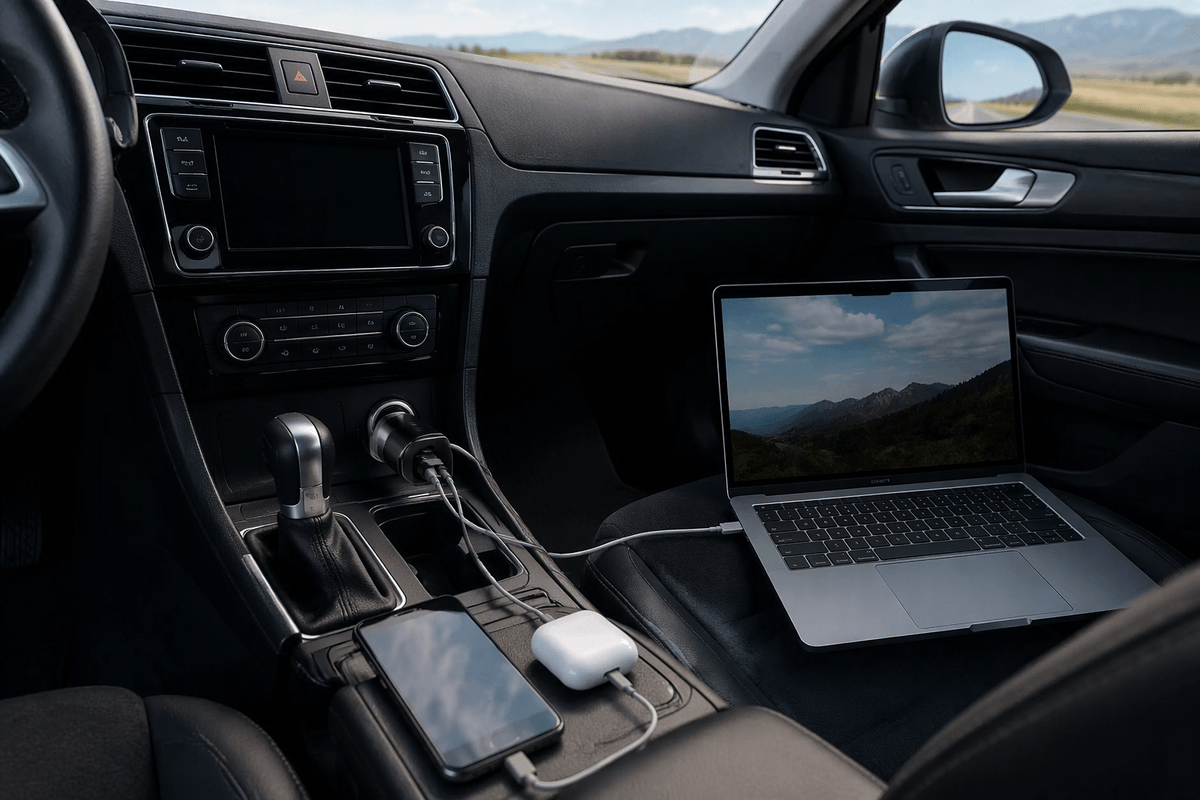
On a real drive, the problem is rarely “can I charge this?” and more “can everyone charge at once without the plug getting loose or the fuse popping?” A simple, dependable setup is a snug 12V plug adapter with one high-power USB-C PD port (45–65W) for a laptop, plus one or two lower-power ports (USB-C or USB-A) for phones and accessories. Put the laptop on the PD port, then treat everything else as “background charging” and rotate devices if speeds get slow.
If you also need a wall plug (camera charger, older laptop brick), run a small inverter only when necessary, and keep it as the only heavy load while it’s in use. Set the inverter where it can breathe, not buried under a jacket. Use short, good cables, route them so they won’t snag a shifter or pedal, and plan for one practical limitation: cheap splitters and long cords add clutter, loosen over bumps, and often run hotter than a single quality adapter.
Staying safe: heat, battery drain, and electrical protection
You’ll usually feel the problem before you see it: a plug that’s getting hot, an inverter that’s too warm to hold, or a charger that keeps cutting in and out over bumps. Warm is normal; hot means reduce the load, reseat the plug, or swap to a better-fitting adapter. Keep converters in open air, not wedged in a cupholder full of receipts.
Battery drain is the other surprise. Charging a laptop and a couple phones for an hour with the engine off can take a meaningful bite out of a starter battery, especially in older cars or cold weather. If you need power while parked, run the engine periodically, or use a dedicated power station. Stick to the vehicle’s fuse rating, use the right fuse type, and avoid “bigger fuse” shortcuts—overheating wiring is how small problems turn expensive.